
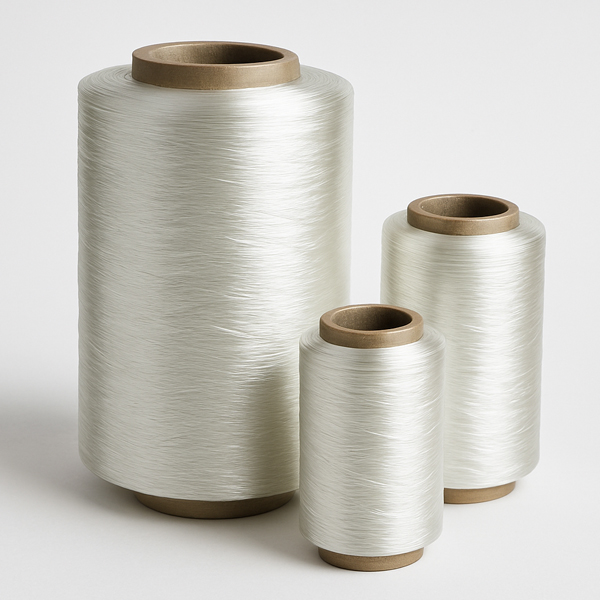
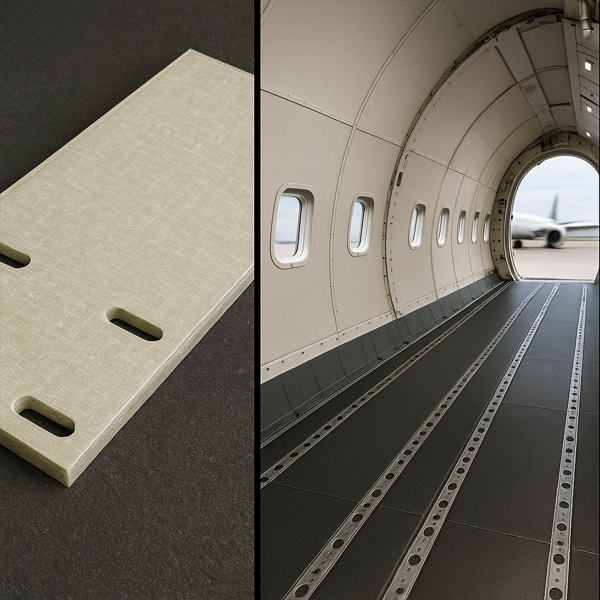
S-glass yarns offer superior performance compared to E Glass fibers. These fibers provide 30-40% higher tensile strength, 16-20% higher modulus of elasticity, 10 times better fatigue resistance, and can endure temperatures up to 100-150 degrees higher than E Glass fiber. Additionally, they boast excellent impact resistance, high ageing and corrosion resistance, and quick resin wet-out properties. With features like high tensile strength, superior temperature endurance, enhanced fatigue resistance, excellent impact resistance, and quick resin wet-out properties, In aerospace, they are used in lightweight fuselages, space structures, and rotor blades. In the marine sector, they enhance boat hulls, mast components, and underwater structures. For defense applications, S-GLASS fibers provide unmatched protection in armored vehicle panels, body armor, and military vehicle components.
S-glass fibers possess a higher tensile strength than E-glass fibers. The tensile strength of S-glass is typically about 4,500 MPa (650 ksi), which is approximately 40% higher than that of E-glass, which has a tensile strength of about 3,450 MPa (500 ksi). This makes S-glass fibers more suitable for applications where high strength is critical.
S-glass has a higher modulus of elasticity compared to E-glass, indicating that S-glass is stiffer. S-glass’s modulus is typically around 87Gpa(12.6Msi), while E-glass has a modulus of about 72 GPa (10.5 Msi). The higher modulus means that S-glass fibers are less likely to deform under load, making them ideal for high-performance applications.
S-glass fibers retain their high strength and modulus at higher temperatures compared to E-glass. S-glass can be used at temperatures up to about 1000° F (540°C), significantly higher than E-glass, which starts to lose its mechanical properties above 600°F (315°C). This makes S-glass a better option for applications involving high thermal loads.
S-glass has better impact resistance due to its high-energy absorption capability. This means that structures made with S-glass composites can withstand more impact before failure, which is crucial for applications such as military vehicles, aerospace, and sporting goods.
| Tex | Twist(t/m) | Breaking Strength(N) |
| 12 | 55 | >7.2 |
| 24 | 55 | >14.4 |
| 48 | 55 | >28.8 |
| 72 | 55 | >43.2 |
| 112 | 100 | >67.2 |
| 66 | 55 | >39.6 |
| 66 | 55 | >39.6 |